
1. I Started Detailing Cars at 13. Here's How That Led to Building An AI Company.
2. From Frankenstein to Rankenstein: How we grew Gateway Auto from $3M to $11M
3. We built the wrong thing for eight months before pivoting into Service Stories
5. The Numbers Didn't Look Real. They Were.
Next: A Course Correction Towards A New Northern Star
I've done a lot of things in my life that I'm proud of.
I keynoted stages around the world. I appeared in the most-watched technology documentary in world history. I wrote a book. I testified in an antitrust case against Google. I've help draft and enact laws to make our internet safer.
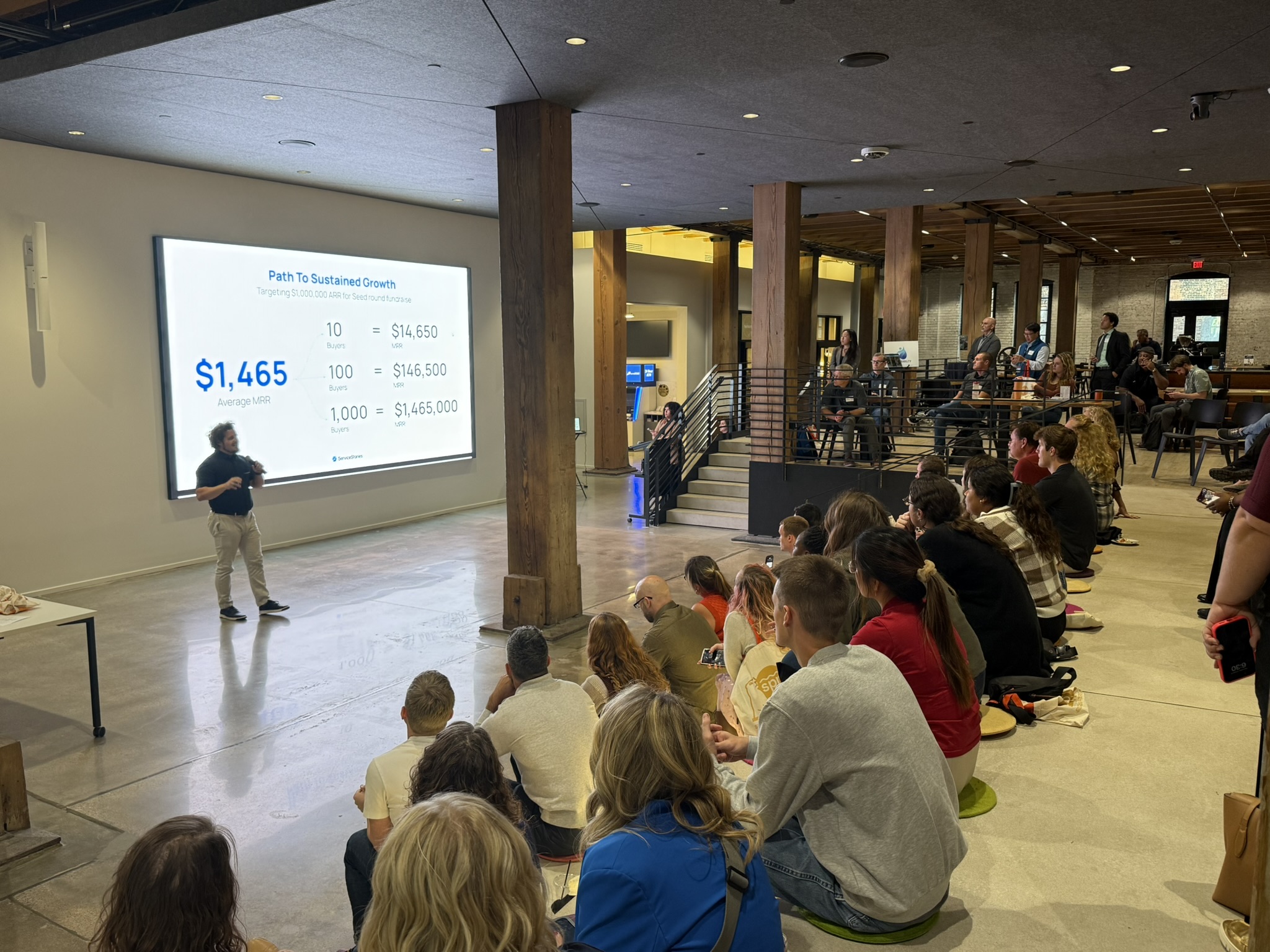
Nothing felt as good as the day we won Silicon Prairie Startup Week.
It wasn't the $10,000. It wasn't the year of free co-working at Catalyst Omaha. It was standing in front of a room full of people who had no reason to hand us anything, pitching a product that was still early, and watching them get it. Immediately. No convincing required. The problem was obvious. The solution was obvious. The reaction was: why didn't someone do this sooner?
That was the moment I understood we had something that didn't need to be explained. It just needed to be seen.
Company updates from August through October read like a memoir: August 5: Pilot customers see early AI rank increase. August 19: Service Stories doubles MRR month over month. September 3: First pilot in the medical services industry. September 16: AI traffic up 213% in 90 days. September 30: Service Stories accepted to Techstars Omaha Founder Catalyst Program. October 8: Service Stories wins Silicon Prairie Startup Week Pitch Competition. October 15: Service Stories doubles MRR month over month. Again. October 30: New marketing site live. Targeting $10,000 MRR in 90 days.
Each line is two weeks of work compressed into a sentence. Behind each one were calls, builds, tests, and spreadsheets nobody outside the company ever saw. But the direction never changed. Every data point pointed the same way.
Techstars Omaha Founder Catalyst Program acceptance didn't come with a check. We applied because we wanted deadlines. Pressure. A cohort that would hold us accountable on a timeline that matched where we were in the build.
What we got was that, plus the external confirmation that people who evaluate hundreds of early-stage companies every year looked at what we were building and said yes. That matters — not because institutional validation means everything, but because it means you're not just convincing yourself.
By the end of September we had two active pilots generating content. Just two. And the charts were already doing things we had to check twice to believe.
Gateway Auto hit a 404% increase in direct web traffic within five months. Posting three times a week. On a shop that was already reasonably well-optimized before we started. The number wasn't a projection. It wasn't theoretical. It was sitting right there in the analytics — verified, unedited, real.

We kept asking ourselves the same question: what happens when we go daily? What happens when we go multi-platform?
The New York Times publishes dozens of articles a day. TechCrunch publishes dozens. Every major publisher does, because volume and consistency are how you build topical authority at scale. There's no reason a service business with enough repair orders or project records couldn't operate the same way — each piece unique because each job is unique, the content moat building itself one closed ticket at a time.
We hadn't touched the ceiling. We were just watching it rise.
I've never had a business where I could walk into a room and essentially anyone in it could use the product. That was Hustle Conference in October.
Seven new leads on day one. High-fives from people who'd heard about the pitch competition win, people who'd heard through friends, people who just recognized the problem the moment they heard the name. Getting on a demo call with someone seeing Service Stories for the first time is something I still have trouble describing accurately.
People get it immediately. Not after a few minutes of setup — immediately. The moment they understand that their work orders already contain everything they need, that they've been sitting on years of content without knowing it, you can see it land. And then something even better happens: they start telling you how they'd use it. Their own ideas. Use cases we hadn't built yet, angles we hadn't considered. That's not a customer asking for features. That's a customer seeing your vision and running past you with it.
There is no better signal that you've built something real. They weren't asking what value it provides, how much it costs or even how it works—they were dreaming with us.
Around this same time I went back to writing for Forbes. I'd been away from it for a couple of years, and coming back was deliberate. I wanted to establish my thoughts on AI, especially AI Search, as an AI expert in the field — not just tell people I was one, but demonstrate it publicly, on a platform that carries weight. That's part of the job of being a CEO: get out front, be public-facing, build the credibility that makes the company more credible.
The September pieces came fast: AI Is Destroying SEO. Rank Now Requires Answer Engine Optimization on September 3rd. Why 95% of AI Projects Fail — And 4 Ways To Be In The 5% That Succeed on September 15th. Stop Saying Generative Engine Optimization. It's Called Answer Engine Optimization on September 30th. Three articles in one month, all staking out the same territory: the shift from traditional search to answer engines is real, it's accelerating, and most businesses aren't ready for it.
I've kept writing. The column is ongoing. If you want to follow along, you can find it at Forbes.
New marketing site live. Target: $10,000 MRR in 90 days.
When we wrote that number down, it wasn't a wish. It was a declaration. We had been doubling month over month, month after month. We had pilots converting. We had proof across multiple industries. We had a product that sold itself on a demo call and a market that was moving toward us whether we pushed or not.
When it feels like nothing can go wrong, you stop checking for what might. We were at the top.
Next: A Course Correction Towards A New Northern Star
Service Stories helps service-based businesses turn their daily work into content than ranks in Google and gets mentioned by AI search like ChatGPT
Book Demo